The Business Value of Product Stewardship
Product stewardship, when treated as a core business strategy rather than just compliance, offers measurable advantages like stronger market access and reduced regulatory risk, positioning organizations for long-term viability.
The Business Value of Product Stewardship
Why Smart Organizations Are Investing in Stewardship — Not Just Compliance
Product stewardship is often described as a compliance function — something organizations adopt to meet regulatory requirements, manage product risks, and avoid the cost of non-compliance. But compliance is only the floor. Stewardship is also a business strategy.
Organizations that treat stewardship as a core capability — not a regulatory checkbox — gain measurable advantages: stronger market access, lower regulatory risk, more resilient supply chains, and greater stakeholder confidence.
This article explores what the business value of product stewardship looks like in practice, why that value is growing across Canada and globally, and how organizations can begin to measure and communicate it internally.
At its foundation, product stewardship is a system of lifecycle governance: ensuring that accountability for a product's impacts is clearly assigned, consistently exercised, and defensibly documented across every stage of the product's life. It is also a model of cross-functional accountability — recognizing that no single team owns the full lifecycle, and that stewardship only delivers value when product design, procurement, legal, sustainability, and commercial functions are aligned around shared objectives.
Earlier articles in this series examined what product stewardship is, how it connects to environmental law, regulatory affairs, and EHS, and how it supports risk management, sustainability, and emerging technologies like AI. This article builds on those foundations by focusing on what stewardship delivers — and why organizations that invest early are better positioned for long-term product viability.
What We Mean by Business Value
Business value in product stewardship is not only financial. It is also strategic, reputational, and operational.
Organizations derive value from product stewardship in several connected ways:
- Market access — meeting regulatory requirements that determine whether a product can be sold in a given market
Risk reduction — identifying compliance gaps, liability exposures, and supply chain vulnerabilities before they become costlyOperational efficiency — streamlining how the organization identifies, assesses, and responds to regulatory changeStakeholder confidence — demonstrating responsible product management to customers, investors, regulators, and the publicLong-term product viability — ensuring that products remain legally compliant, commercially viable, and environmentally defensible over time
These forms of value are interconnected. An organization that loses market access due to non-compliance also loses revenue, reputation, and stakeholder trust simultaneously.
From Reactive to Proactive: A Shift in Organizational Posture
Many organizations first encounter product stewardship as a reactive function — responding to a new regulation, a customer inquiry, or a compliance incident.
Reactive stewardship asks: What do we need to do to comply?
Proactive stewardship asks: What are we doing to remain viable, competitive, and responsible — before compliance becomes urgent?
The shift from reactive to proactive is where the business value of stewardship becomes most visible. Proactive organizations monitor regulatory developments before they become obligations, assess product impacts before market entry, engage with PROs and regulators as partners, and build internal capability so that stewardship knowledge is embedded — not dependent on a single individual or external consultant.
📊 Visual 1 — Stewardship Value Quadrant
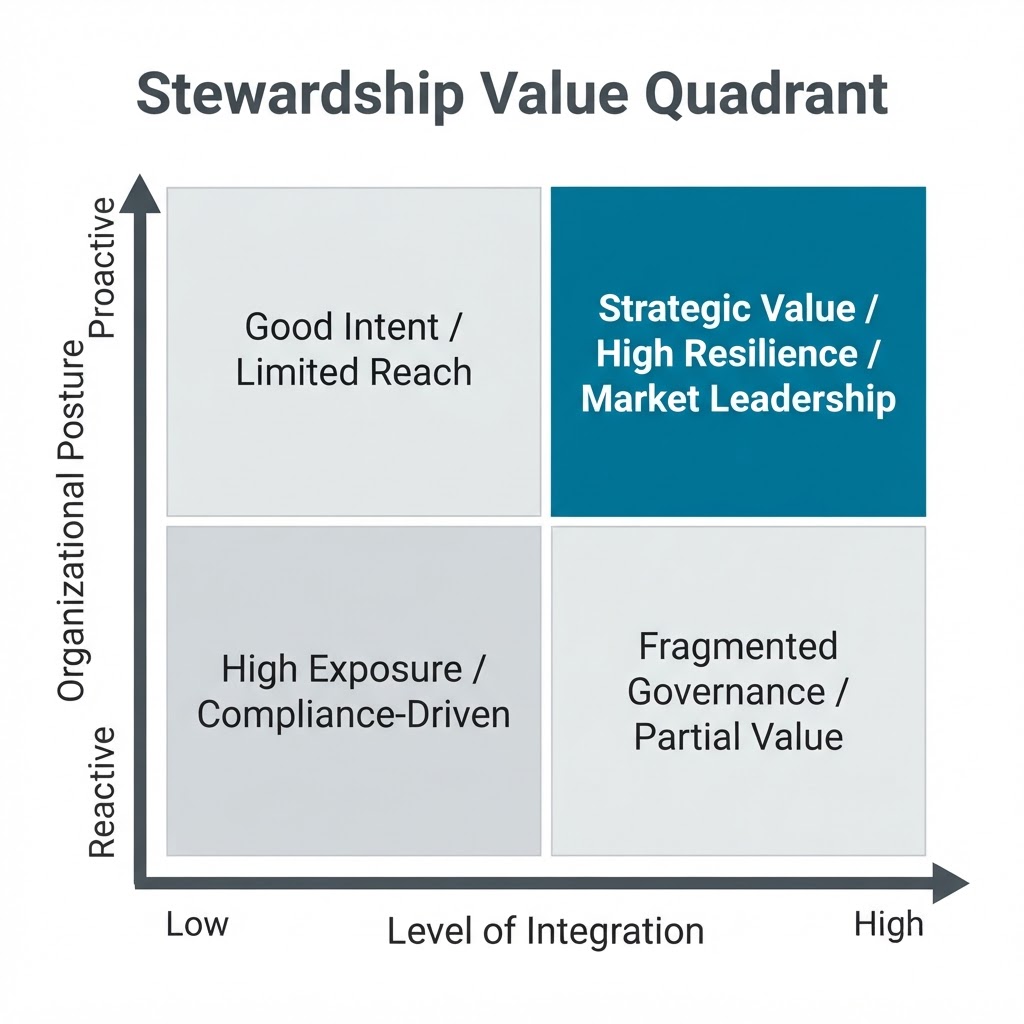
Organizations in the upper-right quadrant consistently outperform peers on regulatory preparedness, market retention, and stakeholder trust.
The Canadian Context: EPR as a Business Driver
In Canada, this is increasingly relevant as provincial EPR programs expand nationwide — each with distinct product categories, timelines, and compliance obligations even though there is a standardization underway.
Producers operating across multiple provinces face layered obligations — managing packaging, electronics, batteries, lamps, and hazardous materials under different regulatory frameworks, fee structures, and reporting requirements. For organizations without a stewardship function, this complexity is a liability. For those with one, it is navigable — and even anticipatable.
In Ontario, the January 2026 transition to full producer responsibility under the Blue Box program shifted the financial and operational burden of recycling from municipalities to producers. Organizations that had invested in stewardship capability understood this transition early, prepared their reporting systems, and avoided the disruption experienced by those who had not.
Canadian stewardship programs also serve as a reference point internationally. Understanding how Canada's federated EPR model functions — with its mix of provincial regulation and PRO-managed programs — is increasingly relevant for organizations with global operations or international trade exposure.
📊 Visual 2 — Stewardship Capability Maturity Model
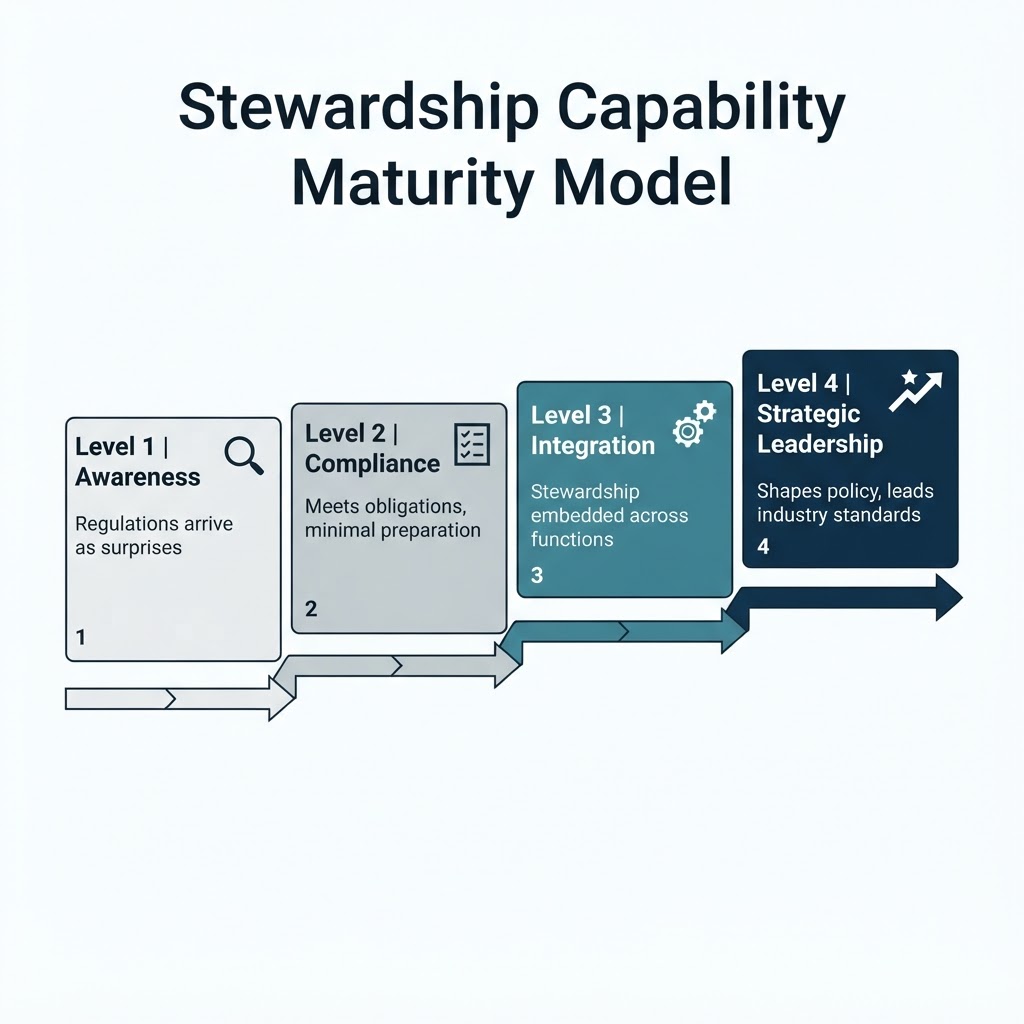
Organizations at Level 1 react to regulations. Those at Level 4 help write them.
A Shared Governance Foundation
Product stewardship delivers its greatest value when it is supported by strong governance. Governance in this context means more than oversight. It means the organization has:
Clear decision rights — who is authorized to make product-related stewardship decisions, and under what conditionsTraceability — the ability to track a product's regulatory history, substance profile, and compliance status across its lifecycleDefensibility — documented evidence that decisions were made on the basis of sound information, appropriate expertise, and deliberate processDocumentation discipline — consistent records of regulatory assessments, approvals, supplier communications, and compliance actionsData quality — reliable, auditable information that supports both internal decisions and external reporting obligations
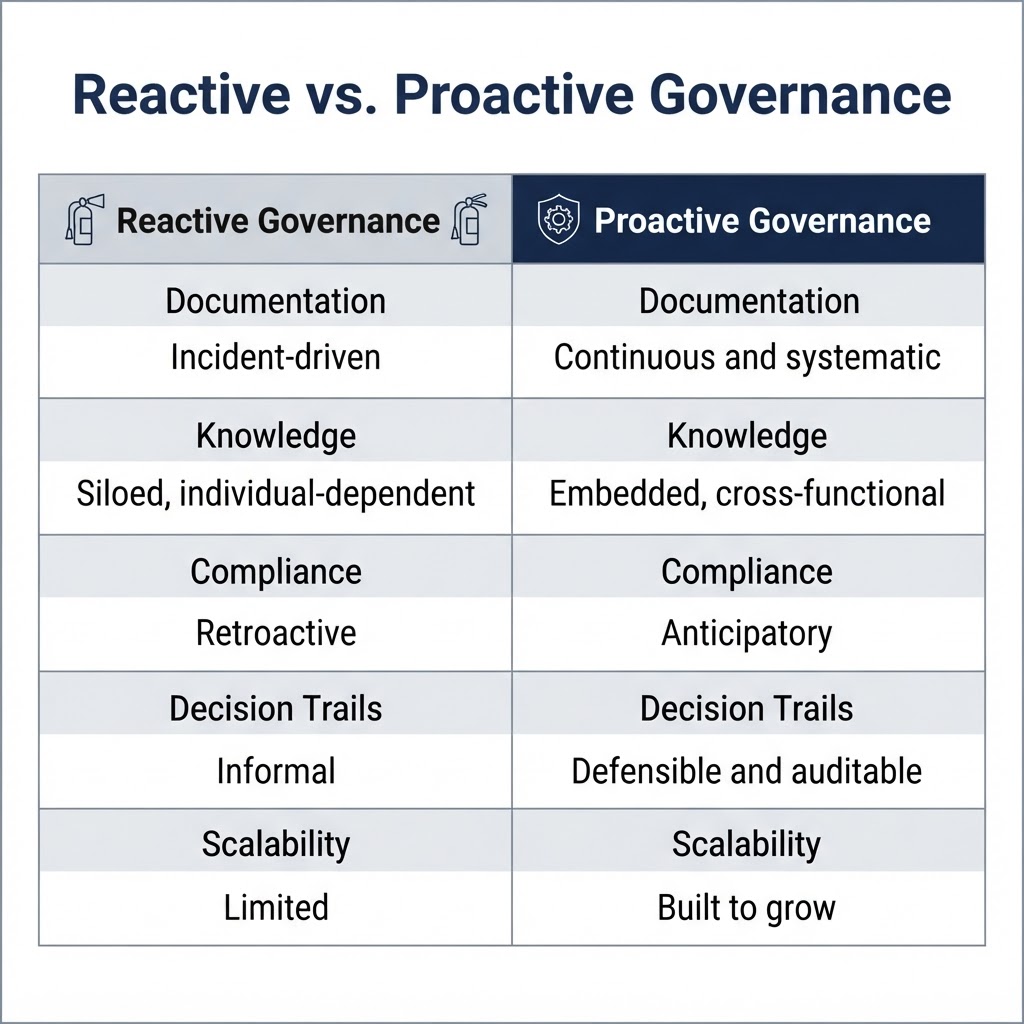
Without governance, stewardship activity exists but cannot be verified. Regulators, auditors, customers, and investors increasingly expect organizations to demonstrate — not merely assert — that their products are responsibly managed.
📊 Visual 3 — Reactive vs. Proactive Governance
A Real-World Example: Ontario's Blue Box Transition
Ontario's transition to full producer responsibility under the Blue Box program illustrates how stewardship capability creates measurable business value.
Producers who had invested in stewardship programs before the transition were able to understand their obligations early, engage with PROs as informed participants, prepare reporting systems to meet RPRA's requirements, budget accurately for fee obligations, and communicate confidently with retail partners and municipalities.
Those without stewardship capability faced a steeper adjustment — absorbing both the direct costs of compliance and the indirect costs of late preparation, including operational disruption and stakeholder concern.
The difference was not the regulation. It applied to all producers equally. The difference was readiness — and readiness is a product of sustained stewardship investment.
Stewardship as Competitive Differentiation
Organizations that have invested in product stewardship increasingly use it as a market signal. Ret