Why Traceability Matters in Product Stewardship
Traceability is the operational backbone of product stewardship, enabling defensible governance and verifiable compliance across a product's lifecycle. Organizations that master this capability can demonstrate accountability and confidently participate in circular economy systems.
Why Traceability Matters in Product Stewardship
Knowing Where Your Product Has Been — and Where It Is Going
Product stewards ensure that organizations take responsibility for their products across every stage of the lifecycle — from the sourcing of raw materials to the management of products at end of life. But accountability without visibility is incomplete. An organization cannot be responsible for what it cannot see.
This is where traceability becomes essential. Traceability is the ability to track a product — its materials, its movements, its regulatory history, and its decisions — across the supply chain and throughout its life. It is not simply a data management practice. It is the operational backbone of product stewardship: the system that makes governance defensible, compliance verifiable, and lifecycle responsibility real. Earlier articles in this series explored the disciplines and functions that surround product stewardship — environmental law, regulatory affairs, EHS, risk management, sustainability, and AI. The previous article examined the business value of treating stewardship as a strategic capability. This article goes deeper into one of the core capabilities that makes that strategy work: traceability.
What Traceability Means in Product Stewardship
Traceability in a product stewardship context means knowing: • What materials and substances are in a product, and where they came from • Which regulations apply to those materials in which markets • How the product has moved through the supply chain — from supplier to manufacturer to distributor to end user • What decisions were made about the product, by whom, and on what basis • How the product is managed at end of life — collected, recycled, recovered, or disposed of. Traceability is not a single system or a single data field. It is a connected record — built across functions, suppliers, and lifecycle stages — that allows the organization to answer the question: can we demonstrate, with evidence, that this product has been responsibly managed?
Why Traceability Has Become Non-Negotiable
Regulatory expectations have shifted significantly in recent years. Regulators are no longer satisfied with declarations of compliance. They expect documentation. Customers and institutional buyers are asking for verified sustainability claims, not marketing language. Investors are applying scrutiny to supply chain risks that were previously considered outside the scope of financial disclosure. In Canada, this shift is visible across the expanding EPR landscape. Provincial programs increasingly require producers to demonstrate, not simply assert, that their products are being managed according to plan. Reporting obligations, audit rights, and fee structures are all moving toward greater transparency and accountability. Globally, the European Union's Digital Product Passport initiative — which will require manufacturers to maintain and share structured product data across the supply chain — signals where regulatory expectations are heading. Organizations that build traceability capability now will be positioned for these requirements. Those that do not will face them as a crisis.
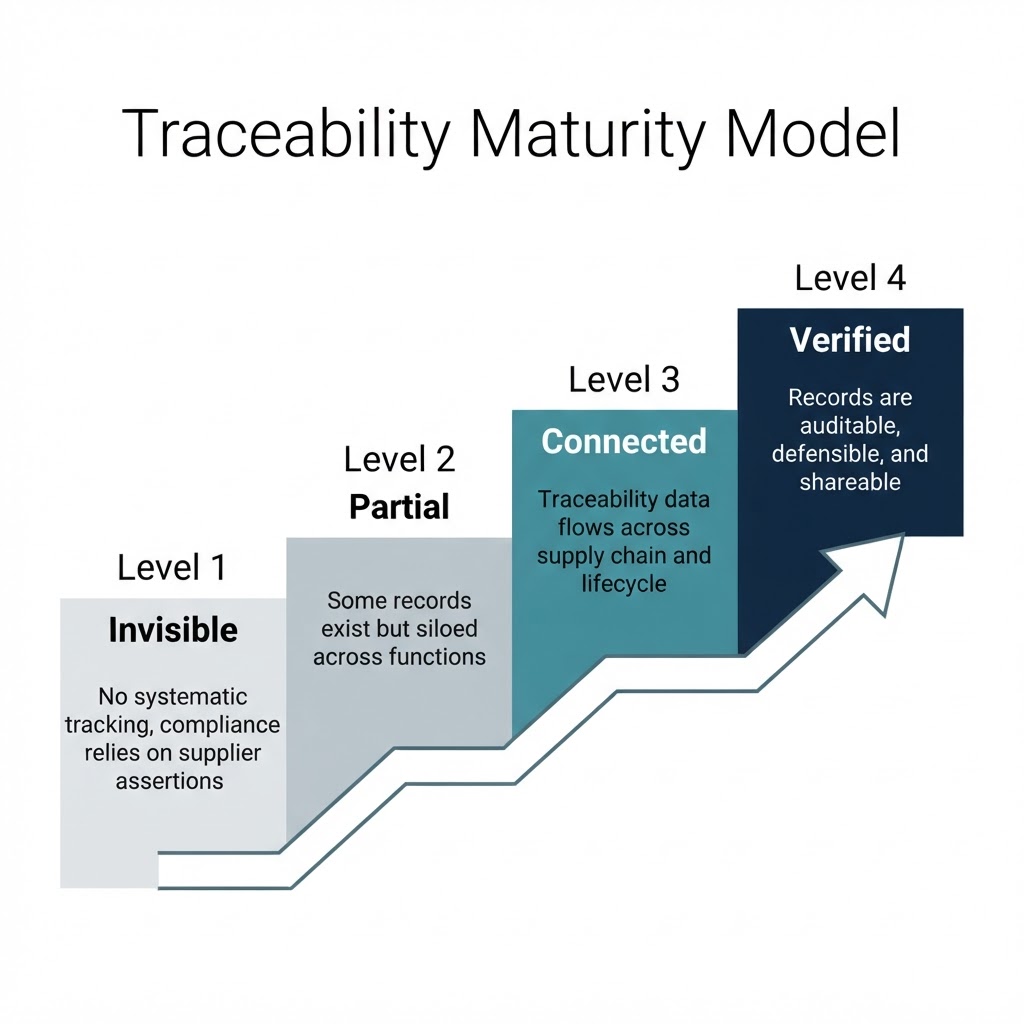
Visual 1 — Traceability Maturity Model
Traceability Across the Product Lifecycle
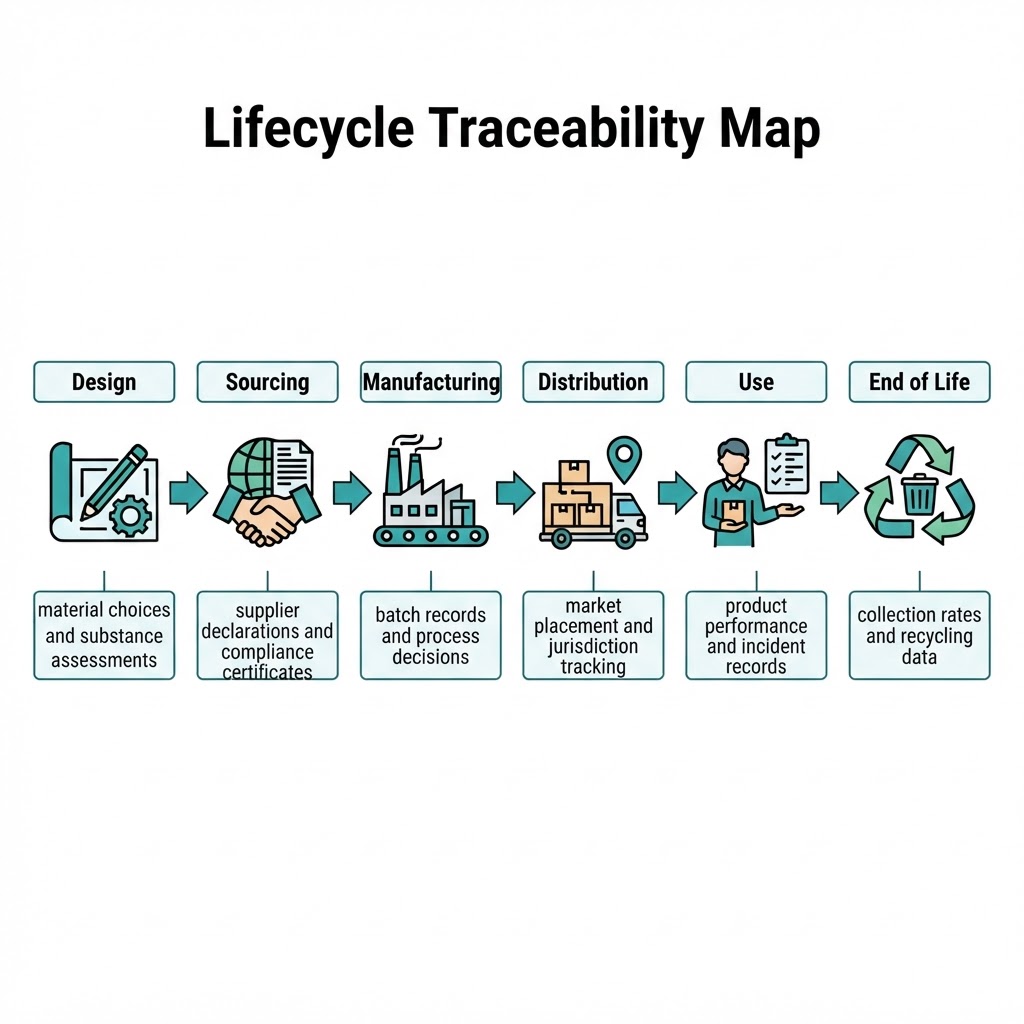
Effective traceability is not limited to the supply chain. It spans the full product lifecycle. At the design stage, traceability means documenting material choices, substance assessments, and the regulatory considerations that shaped product specifications. At the sourcing stage, it means maintaining supplier declarations, certificates of compliance, and test reports that support the organization's claims about what is in its products. At the manufacturing stage, traceability means recording process decisions, batch information, and quality data that connect the finished product back to its inputs. At the distribution stage, it means tracking where products are placed in which markets — because regulatory obligations vary by jurisdiction, and compliance in one market does not guarantee compliance in another. At end of life, traceability means knowing whether products are being collected, processed, and reported according to the obligations of each EPR program the organization participates in. This last stage is where many organizations discover the limits of their traceability — when they need to report on collection rates or recycled content and find that the data simply does not exist.
Visual 2 — Lifecycle Traceability Map
A Shared Governance Foundation for Traceability
Traceability does not happen automatically. It requires governance. The same governance principles introduced in the previous article — decision rights, defensibility, documentation discipline, and data quality — apply directly to traceability. Without clear ownership of traceability data, records become fragmented. Without documentation standards, data collected by one function cannot be used by another. Without data quality controls, traceability becomes unreliable precisely when it matters most. Effective traceability governance asks: • Who is responsible for collecting and maintaining traceability data at each lifecycle stage? • What format and standard must that data follow to be usable across functions and systems? • How is traceability data verified — internally and by external parties? • How long must records be retained, and under what conditions must they be disclosed? These are not IT questions. They are product stewardship questions — and they require cross-functional alignment between product development, procurement, legal, sustainability, and operations.
A Real-World Example: Substance Traceability in Regulated Markets
Consider an organization that sells consumer electronics in the European Union and China. Each jurisdiction has its own requirements for substance restrictions — the EU's RoHS Directive and China's RoHS directive. Each requires the organization to demonstrate that its products do not contain restricted substances above defined thresholds. Without traceability, this is guesswork. The organization relies on supplier assurances that may be outdated, untested, or inconsistently documented. When a regulator requests evidence, or when a substance is newly restricted, the organization has no reliable record to draw on. With traceability, the organization maintains supplier declarations linked to specific product versions, test reports tied to specific batches, and a regulatory watch process that flags when substance limits change. When a new restriction is proposed, the organization can assess its exposure within days — not months. The difference is not just efficiency. It is defensibility.
Traceability and the Circular Economy
Traceability is also foundational to circular economy ambitions. A circular economy requires that materials can be recovered, reused, and reintroduced into the value chain. But recovery is only possible if the materials are known. Recyclers, remanufacturers, and take-back programs need to know what is in a product before they can determine how to manage it responsibly. In Canada, programs and regulations such as EPR and FPR require producers to demonstrate what happens to their products at end of life and also to demonstrate what their products are made of — and whether those materials can re-enter the value chain. This is where traceability connects directly to circular economy basics: the ability to close the loop depends on knowing the loop.
Visual 3 — Traceability and the Circular Economy